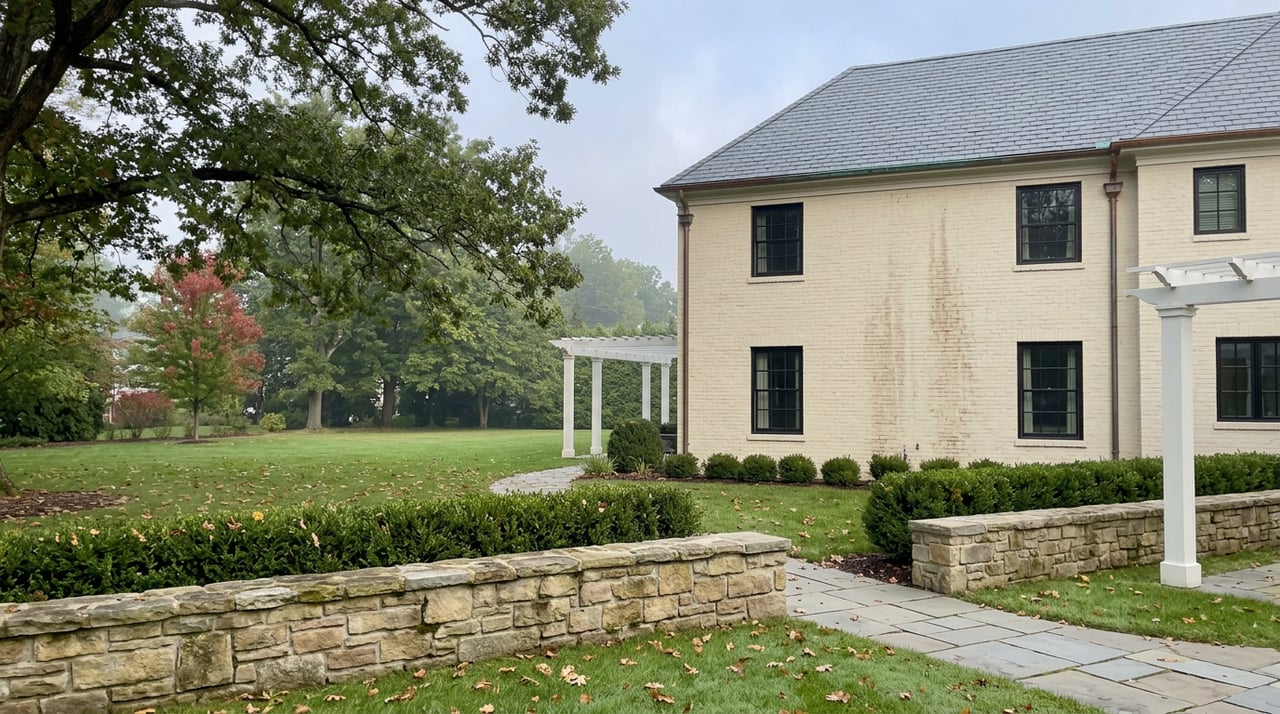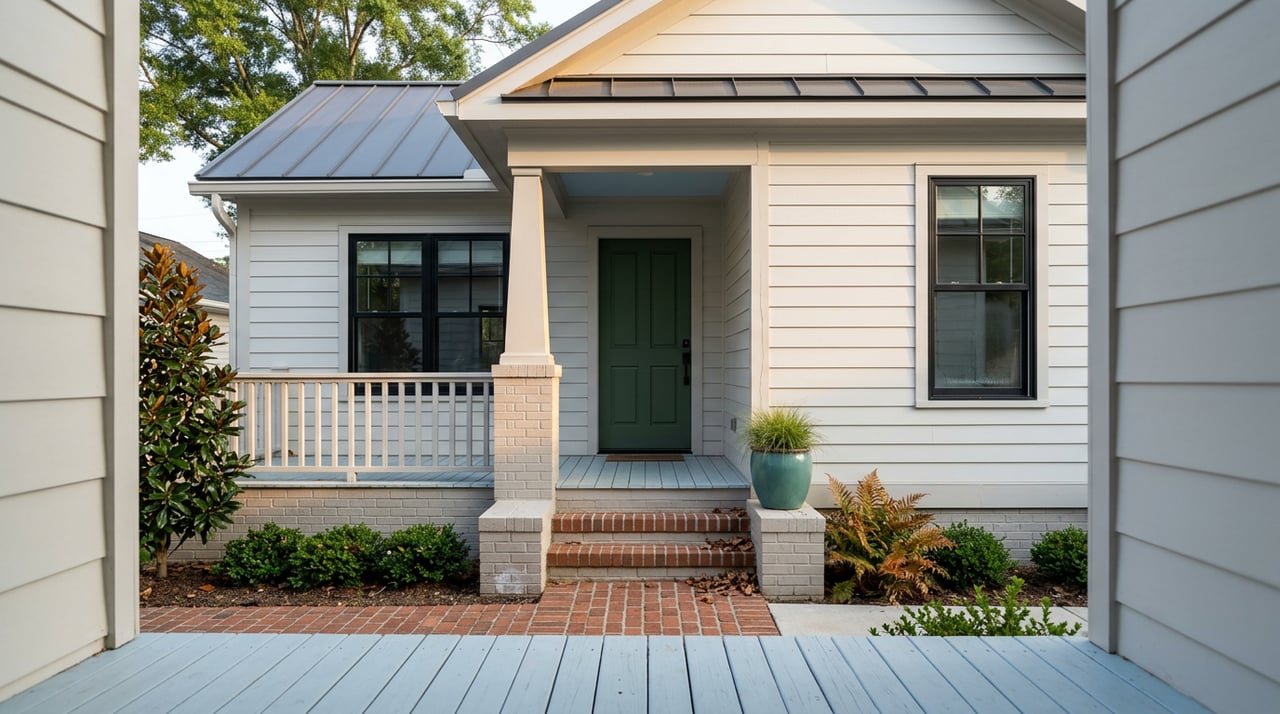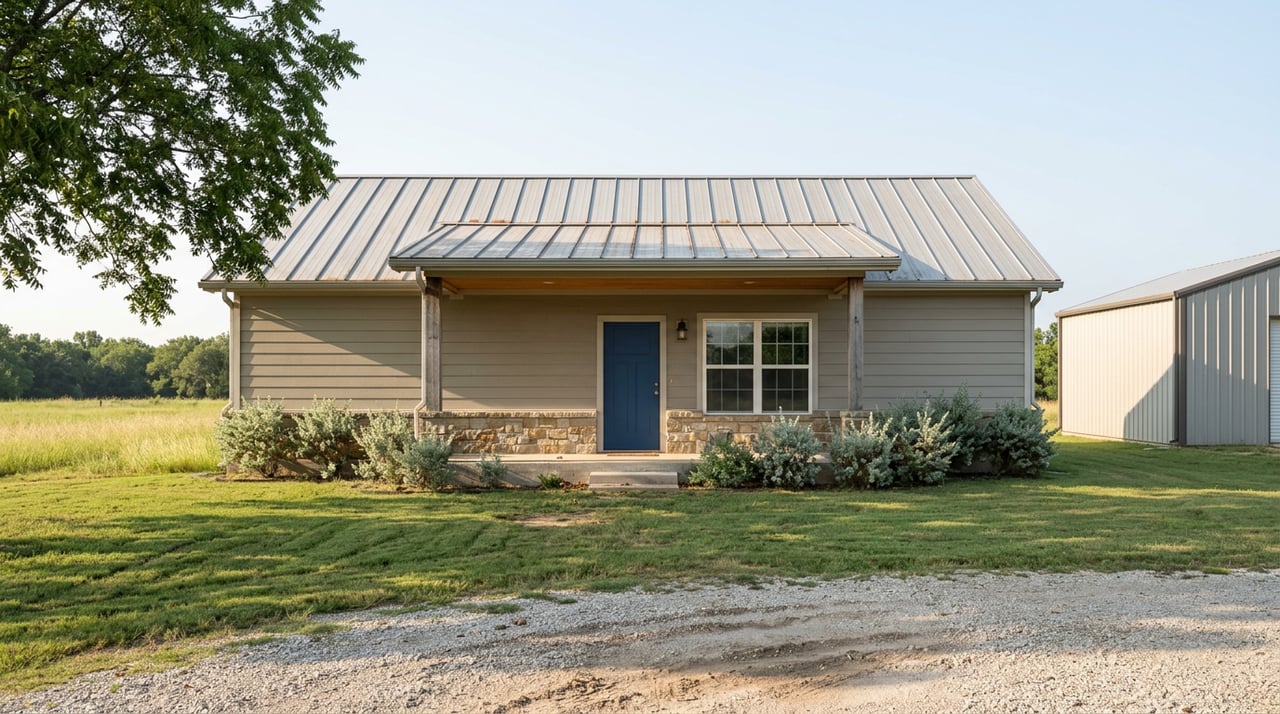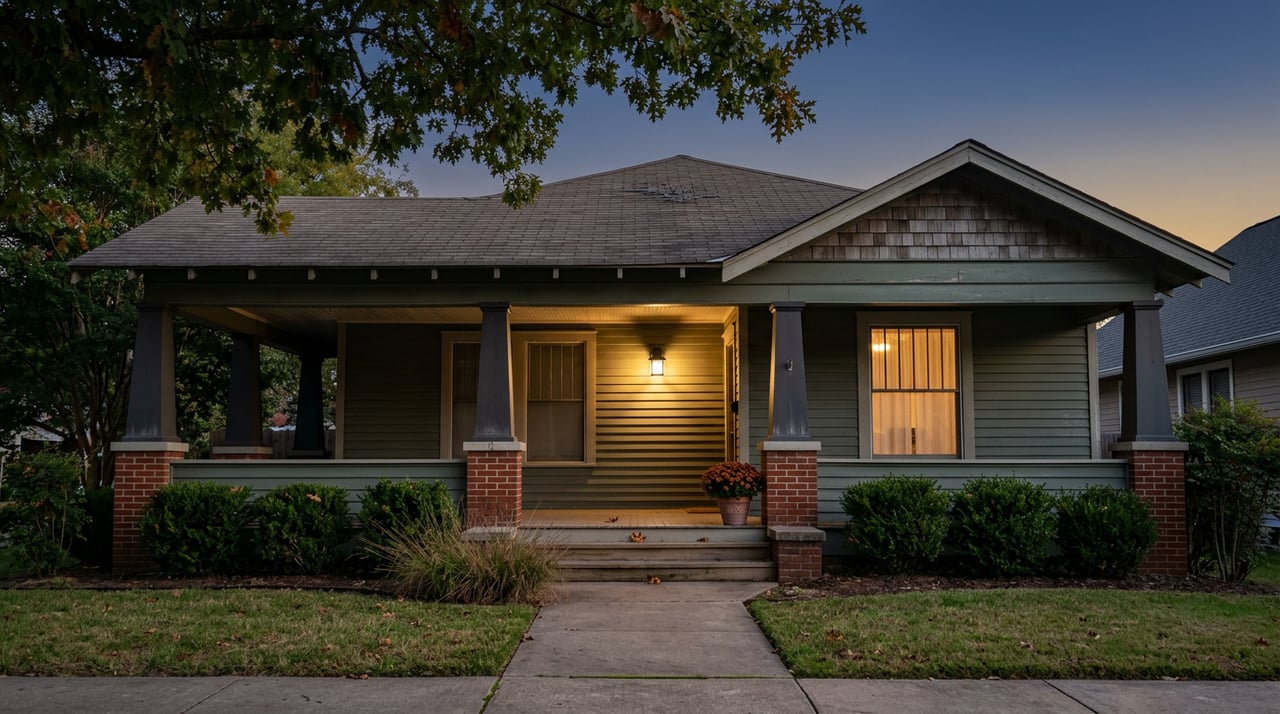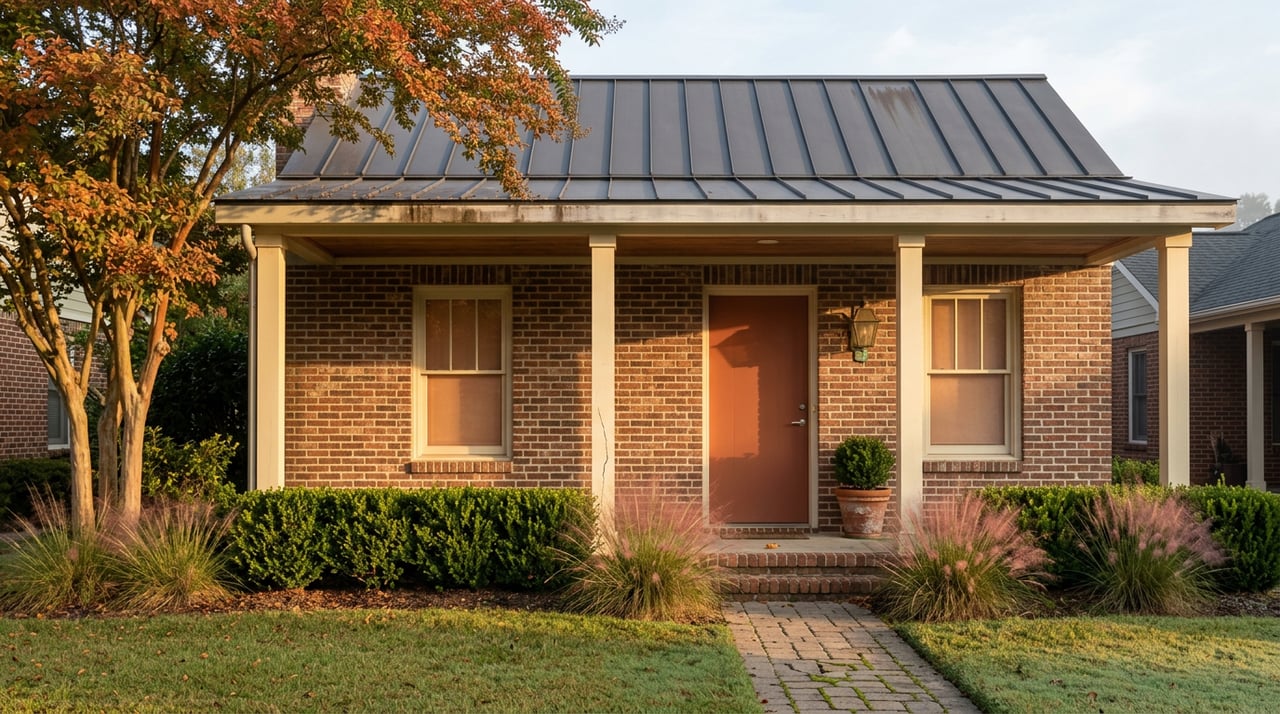
Drive down 9th Street toward Boulevard and you'll pass the kind of ranch houses Edmond has built for sixty years: one driveway, one yard, one mailbox per lot. Then you hit the corner and the pattern breaks. Instead of another driveway, you find two dozen small cottages arranged around a shared courtyard, porches facing inward, cars tucked into shared parking courts out of sight. That's The Ember, a vintage neighborhood of 23 homes of 1, 2 and 3 beds up to 2,100 square feet just a five-minute walk to Downtown Edmond with quick access to Stevenson Park.
The design is the visible part. Underneath it sits a financing structure that makes small, dense infill more profitable to build near Downtown Edmond right now than a traditional subdivision would be. If you're comparing Edmond to other OKC metro suburbs and wondering why the newest homes downtown come with less yard and a higher price tag than what you'd expect for the square footage, the answer isn't really about taste. It's about who's paying for the infrastructure underneath those cottages, and why.
What's Actually Going Up Downtown
The Ember isn't a one-off experiment. It's one of at least two pocket neighborhoods reshaping the blocks around Broadway. The Lark is Downtown Edmond's premier pocket neighborhood featuring luxury living less than a block away from downtown's restaurants and nightlife. A few blocks over, a cottage court development of 10 homes plus commercial space is going in off Broadway and Hurd, known as The Townsend. In the historic Capitol View neighborhood, Colon Holdings LLC is bringing six townhomes with detached garages to a vacant lot near Downtown Edmond.
Even the larger projects follow the same logic of maximizing units on small footprints rather than spreading out. The Oxlley, downtown's newest apartment complex, packs more than 275 units, a pool, a dog park, and a gym onto a site that a decade ago might have held a strip of single-story retail. None of this looks like Edmond's outer-ring subdivisions, where the whole point is a bigger lot for the same money. Downtown is building the opposite bet: smaller footprints, shared amenities, and a price built around location instead of acreage.
The Money Behind the Cottages
Here's the part most buyers never see. Since its creation in 2020, Edmond's first Tax Increment Financing District has helped attract $158 million in private investment in the downtown area and make $17.5 million in upgrades to public infrastructure to support new development. A TIF district works by capturing the future property tax growth from new development and funneling it back into the streets, sidewalks, and utilities that make that development possible in the first place. In plain terms, the sidewalk in front of The Ember and the street improvements around it are partly funded by the increased tax value the project itself creates, not by the city's general fund.
That funding mechanism only works at scale in a compact area. It's a lot easier to justify $17.5 million in infrastructure upgrades when they serve a dense cluster of new rooftops within walking distance of Broadway than when they'd have to stretch across a spread-out subdivision on the edge of town.
Layer a second incentive on top of the TIF district. The Edmond Opportunity Zone is one of 117 special districts in Oklahoma designated to encourage development and investment, and the federal Opportunity Zones program allows investors to realize significant federal tax benefits by investing capital gains in Qualified Opportunity Funds, with benefits that increase the longer the investment is held. That means outside capital has a built-in reason to chase projects inside the Opportunity Zone boundary specifically, and to hold onto them rather than flip them. Combine that with a city that has been rewriting its rules to favor the format. As one industry report put it, Oklahoma City and Edmond have been "updating zoning codes to allow for more walkable and mixed-use development" rather than the wide-lot, single-use pattern that shaped most of Edmond through the 1990s and 2000s.
Put those three things together, a district that recycles its own tax growth into infrastructure, federal tax breaks that reward patient capital, and a zoning code that finally permits the format, and you get a very specific kind of construction: small, dense, walkable, and downtown. Not because builders suddenly fell in love with cottage courts, but because that's where the financing points.
Why Small Lots Pencil Out Better Than Big Ones Right Now
Land inside the TIF and Opportunity Zone boundary is expensive precisely because everyone chasing those tax advantages wants a piece of the same few blocks. A builder holding a 2.3-acre parcel near 9th and Boulevard makes more from the deal by fitting a project designed so residents feel connected via a central courtyard, with private front porches facing a public community park onto that land than by putting up three or four large houses with big yards. More sellable units per acre means more revenue against the same land cost, and Opportunity Zone investors are underwriting projects with exactly that math in mind.
This is also why you're seeing the same developer repeat the format. The Ember is one of two Edmond pocket neighborhoods under development by Matthew Myers of Switchgrass Capital, designed by Union Studio of Providence, Rhode Island. A design and financing formula that works once inside a TIF and Opportunity Zone gets reused, because the incentives that made it profitable the first time haven't gone anywhere.
What This Means If You're House Hunting Near Downtown
If your mental image of a new-construction home in Edmond includes a three-car garage and a fenced quarter-acre, downtown isn't building that product right now. Here's the practical trade-off in plain terms.
| A standard Edmond subdivision | A downtown pocket neighborhood like The Ember | |
|---|---|---|
| Typical setup | One house, one driveway, a private backyard | Homes facing a shared courtyard, private porch, minimal yard |
| What's nearby | More of the same house style repeated down the block | A five-minute walk to Broadway's restaurants and shops |
| Who funded the street and sidewalks | The original subdivision developer, often years ago | Partly the Downtown TIF district, funded by the project's own future tax growth |
| Built for | Buyers wanting maximum square footage per dollar | Buyers trading yard space for walkability and shared design |
Neither option is objectively better. The point is knowing which trade-off you're actually making before you fall for the porch and the proximity to Broadway. A pocket neighborhood home buys you a short walk to dinner and a community built around a shared green space. A subdivision lot buys you square footage and storage. Downtown Edmond's financing structure is currently rewarding the first kind of project, so that's what's getting built, and that's likely to keep shaping your options for the next several years rather than reverse itself.
The Next Wave: Broncho Block
If you want a preview of where this trend goes next, look at the University of Central Oklahoma's own campus edge. UCO is soliciting proposals to build what's being called the Broncho Block on 17 parcels of university-owned property along the west side of University Drive between Ayers Street and East 2nd Street. It's guided by the same University District Plan that's already reshaped the blocks between campus and downtown, aiming to connect the two with the kind of walkable, mixed-use format that's already proven out at The Ember and The Lark.
As of early 2026, this was still a concept stage. It's only a concept right now for UCO students and the Edmond community to start dreaming of what could be, and the university's VP of Finance and Operations said he'd love for folks to reach out with ideas. That means the actual buildings are years out, but the direction is set. If the TIF and Opportunity Zone incentives that built The Ember are still active by the time Broncho Block breaks ground, expect a similar small-footprint, high-density format rather than a return to wide lots.
A Few Questions We Get From Buyers
Does living in a TIF district mean my property taxes go up faster? A TIF district redirects the growth in tax revenue from new development back into public infrastructure within that district. It doesn't change how your individual property is assessed. What it does mean is that the streets, sidewalks, and utilities around new downtown construction are being funded differently than in an older subdivision, which is worth understanding if you're comparing a home's location to its long-term maintenance costs.
Is this a temporary trend or the new normal for downtown Edmond? As long as the TIF district and Opportunity Zone designation remain in place and the zoning code keeps favoring walkable infill, the financial logic that produced The Ember and The Lark stays intact. Nothing in the current plans, including Broncho Block, points toward a reversal.
If I want a bigger yard, should I skip downtown entirely? Not necessarily, but you should adjust your expectations for what "new construction near downtown" means right now. If yard space is the priority, Edmond's outer neighborhoods still offer that. If walkability and design are the priority, downtown's pocket neighborhoods are worth a closer look, with the understanding that you're buying square footage differently than you would in a subdivision.
If you're trying to figure out which side of that trade-off fits your household, or you want a straight answer about what a specific downtown address is actually worth right now, that's exactly the kind of conversation The House Collective Group has with buyers every week. No jargon, no pressure, just a clear read on what your money buys in this market. Let's Connect.